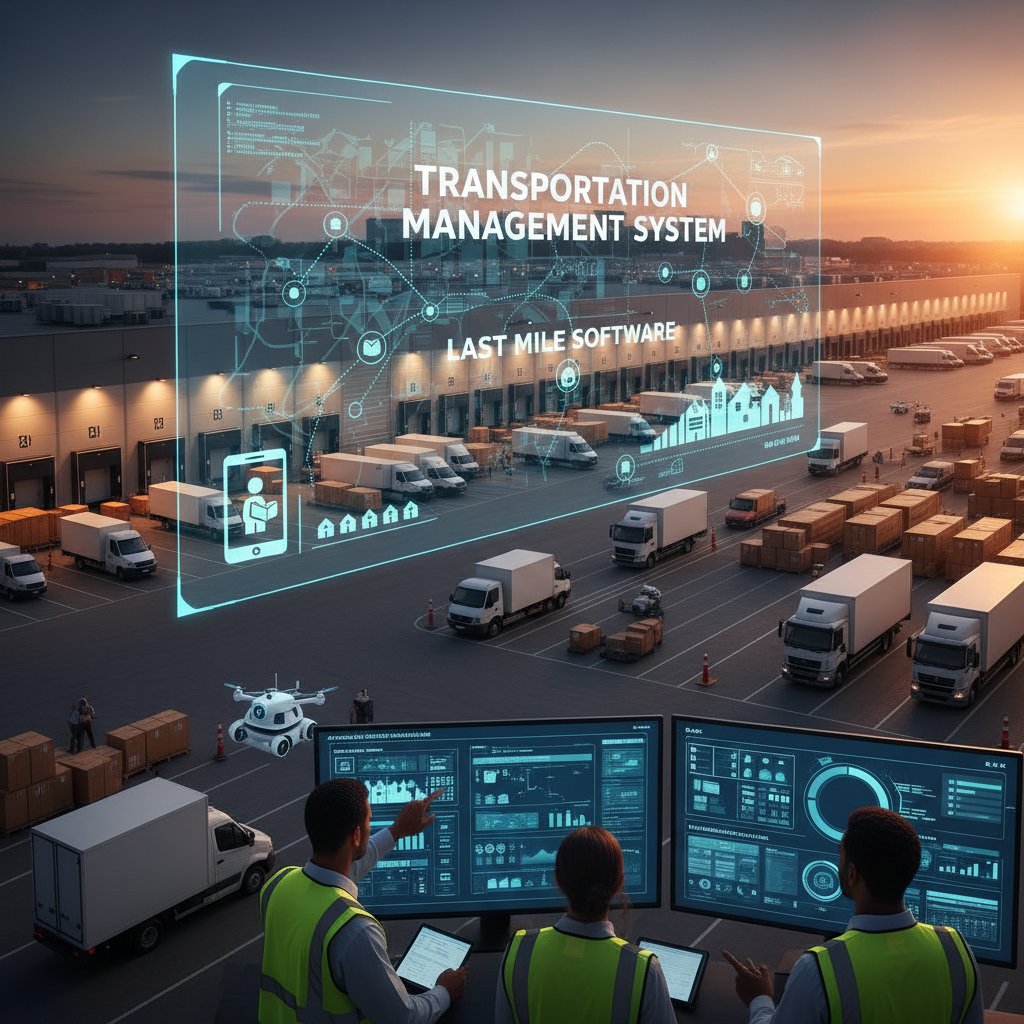
If your business involves moving goods, you've likely encountered a trio of terms that are often used interchangeably: Transportation Management System (TMS), Routing software, and Last-Mile software. While they all live within the logistics technology ecosystem, they are distinct solutions designed to solve different operational challenges. Understanding their specific roles is the first step toward identifying the right technology to drive efficiency and growth in your supply chain. Getting this choice right means the difference between a fragmented, reactive process and a unified, strategic transportation function.
A Transportation Management System, or TMS, is the most comprehensive of the three. It serves as the strategic command centre for your entire transportation operation. Its focus is broad, encompassing the full lifecycle of a shipment, from initial planning and carrier selection through to execution, financial settlement, and final analytics. A true enterprise TMS handles key functions like selecting the best carriers or couriers, estimating costs and predicting delivery schedules, and planning optimal loads. During execution, it provides robust shipment tracking and facilitates customer notifications. Post-delivery, it manages analytics, reporting, and ensures compliance with KPIs and Service Level Agreements. This end-to-end scope means that order visibility is complete, available to both internal teams and external partners from the moment an order is initiated until it is fulfilled. Consequently, a TMS is the ideal solution for businesses with complex supply chains, such as large logistics companies, 3PLs, freight forwarders, manufacturers, and major retailers managing a high volume of shipments across multiple carriers. The primary benefits are systemic: improved overall efficiency, significant cost reductions, enhanced visibility across the network, and ultimately, better customer service.
Routing Management software, in contrast, has a much more specific and tactical focus. Its primary purpose is the optimization of routes and schedules for a fleet of vehicles or a network of transportation partners. While a TMS looks at the entire strategic picture, routing software drills down into the most efficient way to get from point A to point B, and then to C and D, considering factors like traffic, delivery windows, vehicle capacity, and driver hours. Its key functions are therefore centred on route and schedule optimization, detailed vehicle scheduling, and specific load planning for each trip. While it may offer customer notifications, its scope is almost exclusively on the transportation routes themselves. This narrower focus means that order visibility is typically limited, becoming active only when a specific route is planned and ending upon its completion. It is a powerful tool for transportation and logistics companies, particularly those operating their own delivery fleets or managing complex partner distribution networks, especially in the last-mile segment. The benefits are direct and tangible: highly optimized routes, reduced fuel consumption, and tighter control over the transportation network.
Last-Mile software is the most specialized solution, honing in on the final, and often most critical, leg of the delivery journey—from the last distribution centre to the customer's doorstep. In an era of demanding consumer expectations, perfecting this stage is paramount. This software is built to manage the unique challenges of the final delivery. Its core functions include real-time driver tracking for customers, digital proof of delivery capture and verification, precise appointment scheduling, and proactive customer notifications about imminent arrivals. The scope is hyper-focused on this final delivery process, and accordingly, order visibility begins only when the last-mile journey is planned and concludes when the package is in the customer's hands. This type of platform is indispensable for e-commerce retailers, food delivery services, and courier companies. However, larger enterprises are also adopting it to elevate their customer experience. The benefits directly impact the end-customer: more consistent on-time deliveries, dramatically increased customer satisfaction, and reduced operational and administrative costs through automation.
While these systems serve different functions, they are not mutually exclusive. In fact, a sophisticated logistics operation often requires capabilities from all three disciplines to truly optimize its entire delivery process. The challenge, however, is that procuring three separate software solutions introduces significant complexity. You are then faced with the considerable expense and technical effort of building and maintaining integrations, managing different vendors, and attempting to fill the inevitable data and process gaps between the disconnected platforms. This fragmented approach can ultimately undermine the very efficiency you seek to create.
Fortunately, the modern technology landscape offers a superior alternative: the modular TMS. These advanced platforms are designed to incorporate the specialised functions of routing and last-mile management within a single, unified system. A modular TMS includes powerful application capabilities to optimize long-haul routes and control distribution partner networks, alongside dedicated last-mile features to meticulously monitor and manage the final delivery to the end customer. By selecting the proper modules from a comprehensive TMS, you can precisely cover your current operational needs while future-proofing your investment. Should your business model evolve, expand into new services, or alter its logistical flows, the necessary functionality is already part of the core system, ready to be activated.
Our flagship platform, Transporting24, is engineered on this modular philosophy. It is a comprehensive TMS that natively covers all core TMS, Routing, and Last-Mile functionalities. Furthermore, its capabilities extend into other critical areas, including claims management, cross-docking operations, warehouse process integration, and granular cost control. As a modular system, Transporting24 allows you to activate only the components you need to solve today's challenges. At the same time, it provides the peace of mind that as your business grows and your requirements become more complex, the full suite of advanced logistics tools you might need in the future is already available and fully integrated within the platform you already trust.
If you are considering whether a TMS, Routing, or Last-Mile platform could transform your operations, we would love to discuss your specific needs. Send us a LinkedIn message, email info@docuclass.eu, or call +30 210 201 3293.